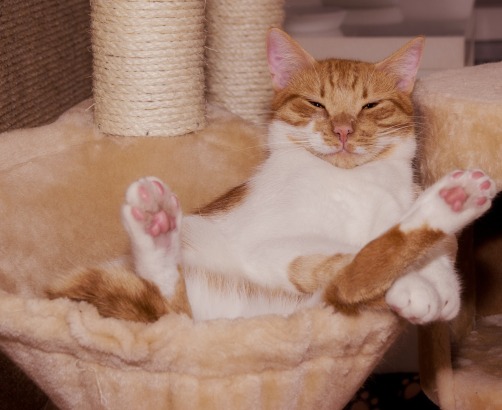
Words are kind of like kittens. They can be fun and enjoyable and very often cute, but they can also cause a lot of trouble … especially when you least expect it.
The more writers use words, the more they realize how darned similar many of them are in several different ways. First you have the homophones. As much as you may want to raise your skill in writing, synoptic misfires can make you feel like you’re more prone to raze your skills, instead.
There are plenty of the “commonly misused” words to watch out for. Although how a kitten can affect your life when you bring one home can lead to an unintended effect, I don’t wish to imply that Kitty will infer that basket of clean laundry is a world-class litter box.
Sometimes it’s not so much the words themselves that are a problem but the way you arrange them. Dangling modifiers or participles are notorious for messing up your intended meaning. Reading the riot act, the kitten stayed out of the basket implies a cat that can read should know better than to mess up your laundry.
Last, but definitely not least, is the plain old typo that creates a different word and therefore spellcheck won’t catch it. You may be tempted to toss that frisky feline out into the snow, but I recommend you never throw it out into the snot.
Ah, the joys of writing and adopting kittens are not so different after all ….
Now that I have your attention, let’s discuss titles:
People these days, even those who love to read, don’t want to spend a lot of time seeking something to peruse. Besides a good book cover, one way to grab someone’s interest is to have a catchy title. There are several elements to consider.
It needs to give an idea of what the story is about, but you don’t want to give too much away. When Tolkien wrote Lord of the Rings as a single volume, the publisher decided to make it into three books. Tolkien was not enamored with the title The Return of the King for the third installment because it gave away the story’s ending.
So-called spoilers might not be so bad, however, in a situation like a historical novel where most people will know what happened, but the journey is the heart of the story. If you title something Lee Surrenders, for instance, we might explore the angst felt by Robert E. Lee at the close of the Civil War.
Or maybe it’s actually a historical romance about a young woman named Lee who must deal with the ramifications when she decides to, well, yield to the guy who’s pursuing her.
Sometimes titles are no more than the name of the main character. Honestly, I’ve never been a fan of those: Elmer Gant, Robinson Crusoe and Jane Eyre have developed reputations that keep the likes of literature students reading them, but the mere title wouldn’t have drawn me in. Now if the name itself is colorful, like Odd Thomas, that seems like more of a grabber.
Or you could use a combination of provocative and euphemistic by utilizing a substitute name for your plot device. If I see a title like Mary Jane, I might double check to confirm my suspicion that the story is actually about weed.
If you strive for a catchy title, remember to keep some truth in the advertising. While I preferred my more alliterative designation over Sex, Drugs, and Rock and Roll for this post, I also admit my final example doesn’t involve rock music.
Hubby and I once attended a show when, while the banjo and guitar players tuned their instruments, the other two band members engaged in dialogue to pass the time. The lead singer announced the next song they would perform would be an instrumental, something very old that also originated in Tokyo.
“What one is that?” the straight man inquired.
“They’re playing the intro to it now.” He nodded toward the other musicians. “It’s called Tu Ning.”
As I beat a hasty retreat, don’t allow that last illustration to spoil your creativity with titles!
Even though it was iniquitous, Norah cursed the Yuri sentinel she crossed paths with a month ago. If it hadn’t been for him, she wouldn’t now be squatting on her knees in a dark accessory chamber that wafted the aroma of her own sweat and blood and amniotic fluid.
Instead of hiding in a rust bucket of a space freighter, she was supposed to be at home with her husband at her side while a human midwife assisted with the birth of their child. Although she was grateful to have Wadima from Karthonatus crouched before her, Norah didn’t bother to ask if the elderly alien had ever before delivered the offspring of a differing species.
Before the next contraction set in, she admitted the pesky Yuri was only a link in a chain of calamities. She set to cursing the Voratene. Norah was only a child when they launched their plan of subjugating the aligned worlds and committed genocide against the one species most likely to stop them.
“Crown.” As a seasoned interstellar traveler, Wadima possessed an impressive grasp of other languages, but was still a minimalist with words.
She’d been helping Norah and her husband Kelwin with evading their pursuers for the past four days. Luckily for them, the Voratene had many enemies. Although the individuals who’d facilitated their escapes had no comprehension why the expecting couple was being hunted, they were gratified to commit any act of defiance against their oppressors.
Even Wadima had little idea that the baby about to emerge had been branded an enemy of the empire a month ago. The Voratene decreed the child must die because that Yuri sentinel “prophesied” the fetus she carried would become instrumental in a successful rebellion.
For many seconds Norah focused on pushing, straining to usher the baby from her warm and protective womb into a cold and hazardous universe. She braced her arms on either side of the tubular structure that served as a conduit to facilitate maintenance on the ship’s systems.
How ironic that Kelwin’s child would be born in an accessory chamber. Her husband was a skilled mechanic who serviced and repaired a variety of astro-craft, and his knowledge of their layouts and hidden corridors were essential to their fugitive status.
As her contraction subsided, Norah gave up cursing and embraced praying. She had been left alone with Wadima because only an hour ago a Voratene squadron boarded the ship to conduct a routine search. They were already hidden, but Kelwin was unwilling to simply hope that his laboring wife wouldn’t be discovered in this dark tube. He left to surveil their movements and, if necessary, divert them.
The next urge to push overwhelmed her, and Norah was grateful Wadima was of a species adapted to low light. To the humans her race was reminiscent of long-necked naked mole rats with large eyes. They even had stubby tails, but those were concealed by the drab, jumpsuit-style garments they wore. Their ability to see well in darkness compromised their color perception.
Norah lost track of how many times she pushed, and Wadima didn’t give any more updates on progress. Her alien midwife blurted something in her native language, and quickly followed with the announcement “Boy!”
The infant squawked and Norah collapsed to a sitting position. “How is he?”
A few seconds passed before she replied. “Strong.”
Norah wished she could see her son, and when Wadima pressed the boy into her arms she snuggled him to her chest. He still only occasionally squawked, perhaps because the darkness was familiar to him.
And then the ship shuddered while a wailing, creaking groan seemed to emanate around them.
She clutched the child tighter and hoped her racing heart didn’t frighten him into crying. “What was that?”
A few seconds passed before Wadima spoke, her tone detached. “Breach.”
Norah clamped her lips together and struggled to swallow the lump in her throat. She heard Wadima tap on the metal around them.
“Airtight.”
It was more than concern for her son’s safety that terrified her. Yes, these ships were compartmentalized to avoid everybody dying should there be a hull breach, but what if Kelwin had been in its vicinity?
If she lost him, she didn’t know if she could continue evading their pursuers and protect their son. Deep in her heart she knew it would take both of them to sustain this new life she cradled. Tears welled in her eyes as the horror of losing both husband and child overtook her.
Wadima remained silent for what was probably just minutes, but they felt like hours. And then she stated, “Kelwin.”
He had managed to open the hatch door with no noise, and his voice was hushed while he closed it as stealthily as when he entered. “How’s Norah?”
“Son.”
Joy caused her tears to spring loose. “You made it back!”
“I wouldn’t miss this for anything.” He knelt beside her, and Norah fumbled the infant into his arms. She heard Kelwin utter a low, cooing noise as he held the baby.
“Did we have a hull breach?”
“Well, yeah, that was my fault.” There was still awe in his voice. “The Voratene were starting to suspect there were stowaways on board, so I lured them into the ricketiest hold and made sure they had a little accident.”
His report caused a tremor in her chest. Kelwin had always been a practical man, but never before had he ended anybody’s life. His action made her feel as though he’d become a bit of a stranger.
“And therein lies your first lesson,” he murmured to their child. “Never start a fight you can’t finish.”
His paternal advice caused another stir in her chest. The babe in his arms did nothing to start this fight, but she prayed that the Yuri who placed their child’s life at risk would prove to be correct. He just had to survive and grow into the man that would finish it.
###
Here is this month’s submission to #BlogBattle. Let me go ahead and apologize that I won’t be able to respond promptly to any comments. My internet access has become severely crippled for the next week, so I won’t be getting out much in the meantime. Be sure to check out the other stories!
One of the most satisfying things in life is finishing the draft for a book or story. The work isn’t done, by any means, but something (for me, the hardest part) has been accomplished. You’ve reached a goal. You did something a large percentage of the population has never done.
I like to start off with a celebratory libation, and then use the “time off” constructively during the calm before diving into the stormy rewrite.
It’s recommended to walk away from that story for some extended period of time. Most people advise a month, although deadlines might force you to make it shorter. Regardless, you need to give yourself a chance to create distance so you can return to the project with fresh eyes (as opposed to bleary and bloodshot from staring at the blasted thing).
But what do you do with that grace period while it lasts? As a writer, you don’t want to stop writing. Begin drafting the next book you have in mind? Follow up with some research you realized could fill in details for the rewrite? Work on some shorter pieces? Dabble with a book trailer? Read a book?
(I read anytime, but I do enjoy binge reading between projects. It’s a great opportunity to really analyze how another author wrote something you like.)
Writing is kind of like housework and farming: It’s never done. So although this is an enjoyable hiatus when you remember there is a whole other world out there, you don’t quit writing in the meantime. After all, it’s that darned writing bug that got you into this mess in the first place!
Sometimes when hubby reads my manuscript, his comments will include, “Is that a real word?” Now this is a well-educated man, but his focus is in science and the word in question isn’t part of that realm. When hit with such an inquiry, writers face a decision: Keep the word, or substitute it?
We don’t want to insult our readers by talking down to them, nor do we want to go over their heads. Striking that balance in between calls for some judgment and can be influenced by different factors.
Once upon a time in a writing course, we read two versions of one short story. The author had published it long ago in one magazine, and then many years later rewrote it (I think he also changed the title), and it was picked up by a different publication.
The characters of this piece were … well … ahem … white trash, and their son had been struck by a car. In the first story, the mother observed her child taken into the surgery room by “a table on wheels.” In the second version, the author used “gurney.”
I prefer the second version, but I can see why the writer, wishing to reflect the perspective of the characters, illustrated that the mother didn’t know what that contraption was called. So while this example may qualify as “six of one and half a dozen of another,” word choice can also be influenced by keeping your audience in mind.
Sci-fi readers won’t be fazed by statements like “I need to invert the polarity of the harmonics.” They might stop and scratch their heads, however, if someone’s alacrity is referred to (I once got talked out of using that word).
Of course, if the term is spot-on, you can employ the trick of using it in context and give the reader the benefit of being able to figure it out. “She used alacrity in confronting the problem” is less useful than “Her alacrity in getting the polarity inverted saved everyone on the ship.”
(Okay, not the best wording, but you get the point!)
Writers (and readers) love words, but some people are more like walking dictionaries than others. Every word must serve a purpose, and they can be used to both guide and misdirect. But if confusion enters the mix, that rose should go by another name.
P. S. In case you were wondering, alacrimonious is NOT a real word!
“What makes you think I saw anything?” Mr. Burroughs squinted down at them from the top step of his ramshackle porch.
Sage glanced at her husband standing beside her. Rhys’s work as a tracker numbered in the years while she was still new at this, so it made sense for him to guide this conversation.
“We represent a private organization that investigates unusual activities.” Rhys spoke in the fake Georgia drawl that he used to conceal his natural British accent. “The case we’re working on now led us to a wildlife agent in your local game department who reported that two days ago you called inquiring about a naked bear wearing nothing but your tool belt.”
She recognized that Rhys had purposefully misrepresented a detail in what the agent told them in order to spur Mr. Burroughs into correcting him.
His attempt was partially successful. “That’s not what I asked them.”
“Which part did I get wrong?”
The middle-aged farmer with gray stubble on his cheeks regarded Rhys with brows that knitted tighter together. “What organization did you say you were with?”
She didn’t blame Mr. Burroughs for being suspicious. The agent they spoke with was convinced the creaky rustic had nipped too much scrubby moonshine. She and Rhys had a good idea who he had seen, however, and his unbiased testimony was essential to their investigation.
It was time to employ some feminine charm. “We do need your help, Mr. Burroughs.” Sage smiled in a manner that flirted with being coy. “We believe your report was on a subject we’ve been trying to locate for some time. Many people would benefit if you could help us to find it.”
His gaze leveled on her. “So what do you say that I saw?”
She couldn’t tell him the truth. As ancient and widespread as these beings were, they were regarded these days as elements of myth. They sported multiple names like Anthropophagus, Pishachas, Nephil, or Teratism. Rhys had grown up calling them Fomoraig, but Sage couldn’t even use her American term Booger to this man.
When innocent witnesses like him sighted these creatures in modern days, they usually mistook them for aliens. Sometimes she would play upon that mistake while interacting with informants. But Sage ascertained Mr. Burroughs was more skeptical about such matters, so she had to tailor her response accordingly.
“I can only tell you it’s the result of some classified experimentation.” She wasn’t proud of lying. “If I told any more, you would find yourself inconvenienced. I’m sorry, but we are trying to make this as easy for you as we can.”
He stared at her for a few seconds before responding. “At first I thought it was a man, which was why I never shot it. It was after dark, you know, and the dogs were freaking out and barking right at my workshop. So I went to see what the commotion was all about.
“The door was still closed like I leave it every night. I did think maybe some hooligan had slipped in there to steal power tools, so when I went inside, I was expecting to see a person.” Mr. Burroughs inhaled deeply and scowled again. “If that was a person, he’s got serious issues. But a mangy bear doesn’t open and close doors, either.”
“Could you tell what it was doing in your workshop?” Rhys asked.
“Dancing the Macarena, for all I could tell. It was just sort of darting all around the shop, and it was carrying my tool belt around. Only … its head was all shaggy, like it needed a shave and a haircut. But the rest of its body was smooth, though I’m not sure if it was skin or a tight jumpsuit. It kind of woofed after I came in and shot out of there like a greased cannonball … with my belt.”
Her train of thought slammed to a halt and derailed a few cars in the process. His description of the Booger’s behavior didn’t match their other leads. “Did it take anything other than the tool belt?”
“Only what was in it, which was just a hammer and some nails, and a pair of pliers. Believe me, I looked through the place to see if there was anything else missing, while I still thought it could be a person. So, can you tell me if it was a witty bear or a half-wit man?”
What Mr. Burroughs described was unlike any other encounter she’d ever heard of involving these creatures. And considering they’d developed familiarity with this one already, the shift in his behavior made her wonder if this was the same one they’d been tracking.
Considering the description matched that of their target, it had to be the same. Or maybe there really was a stash of tainted hooch on the premises, except it was the Booger instead of Burroughs imbibing nefarious spirits.
There wasn’t much left to this interview, and after they thanked the farmer for his cooperation it was time to head back to the car. Sage was haunted by a nagging sensation that their pursuit had taken a turn for the worse.
“Knickers.” Rhys resumed his native version of English as he started the engine. “This one just had to go and make things interesting.”
Her heart fluttered. “Do you think he knows we’re following him? Could he be trying to lure us into a trap?”
“I’ve seen traps before.” Rhys frowned as he backed the vehicle down the driveway. “It always gets more serious when the hunter becomes the hunted. This is when you embrace the belief that nothing is what it appears to be.”
***
Burroughs stepped back into his house as they drove away, and glanced at the shadowy form lurking in the far corner.
Its voice was a guttural rasp. “Did you tell them what I instructed you?”
“Of course.” Burroughs smirked. “And the idiots believed every word of it.”
THE END
This month the prompt word for #BlogBattle was Shift, so here is my contribution. Follow the link if you want to check out more short stories inspired by this idea!
It’s common for a writer to sit down and begin crafting a book while filled with joy and enthusiasm. It’s also common, somewhere down the line, for that same writer to stare at the unfinished story with dread and contempt.
The honeymoon has ended.
Whether it’s self-doubt or time constraints or that God-forsaken plot twist that contaminated the whole enchilada, all authors can develop a love-hate relationship with their work. This is one of the ways that ninety percent perspiration becomes an annoyance. And good writing, like a good marriage, doesn’t just happen. You got to put some effort into it.
For example, over the last couple of months this blog flowed quite smoothly until this week. It’s been one of those weeks. As my deadline approached, I realized I wasn’t prepared with a topic, and flirted with the notion of skipping out (had lots of practice in that). But I’d made a vow to crank something out each week (barring various disasters), so I determined to see it through.
You’ve heard it before: When life gives you lemons, make lemonade.
The blog and I were at odds, but in itself that presented a topic. Granted, the next time this happens I may be up a creek without a paddle because I’ve used this idea already … or I could come up with an allegory about writing even when your preferred tools are missing.
(I’d better jot that down so I can use it for later!)
So when the shine has gone from the story and instead it looks like something the cat dragged in, don’t give up hope. Sit down with a glass of lemonade and tackle the problem, and then you’ll remember why you wanted to write this in the first place.
While in college I took French to satisfy the foreign language requirement for my degree. One of my instructors relayed a story of his first trip to France back in the early 1970’s. A group he visited with was curious what it was like back in America, and at one point they asked him about, what sounded like, “lazy peas.”
He contemplated this for a few seconds and questioned his fluency in the language. Laissez pees? That still didn’t make sense. And then it dawned on him. They were asking about les hippies, known in English as the hippies.
Using a foreign language in writing can add authenticity to a story if a character is from another culture. But the writer will need to make some decisions. Should you stick to well-known terms like oui (pronounced wee for you non-French readers)? Dare you throw in something most readers won’t understand?
Like any good crime, that will depend on your motivation. If you just want to add color to a character or the setting, use familiar words or brief phrases. Or have another character respond in the native language of the story, thereby divulging that lazy peas spoken of aren’t meant for human consumption.
Maybe you do want to impart some mystery (although readers of that language won’t be stymied). But since a mystery is meant to be solved, you’ll need to make the meaning apparent at some point.
You can also establish a set-up for using terms in another language. For example, in Wail of the Tempest, Alexia is a Cajun and bilingual. She makes a comment about somebody getting the fremeers, and translates to the reader it means “getting the willies.” Later in the story she has an unpleasant interaction with someone that gives her the fremeers. The reader has already been acquainted with that term and understands what it means.
As in all good writing, if it doesn’t add to the story, don’t use it. Otherwise the readers will just be confused by lazy peas running around, and they’re baffling to many people as it is.
Folks will sometimes ask writers where they get the ideas for their stories. The answers can be as varied as the people who give them. Whether it be news stories, articles, or personal experiences, anything can spark an idea. I like to misquote Dante: “I am, therefore I think.”
The real challenge is coming up with stories other people want to read. Now it’s true that the best writing can be something the author would like to read, and authors are people, too (gasp!). But how do you determine if a story has momentum or you’ve just grown close to it because the characters have become your imaginary friends?
(Confession: I have lots of those.)
Multi-culturalism and genre-blending are the trends these days, but the constant that remains in good story telling is creating a conflict that draws readers in and keeps them wanting to find out what happens next.
The point of contention doesn’t have to always be a life-or-death scenario. If the characters become imaginary friends to the readers, you’ve developed another incentive to keep them turning the pages (or swiping the screen). Internal conflict is something we can all identify with, while outsmarting aliens is a bit foreign to most of us.
Would others want to read your story? Back away from your creation and contemplate it as someone just passing through, looking for something to intrigue them. If somebody else wrote this, would you still want to read it?
Yes, it’s a subjective exercise, which is why you hear accounts of best-selling authors getting rejected up-teen times before some publisher realizes that manuscript is gold. Of course, if we could all agree on what we like and dislike, that would probably just make it easier for the aliens to dominate us.
If you should decide, “Hmm, that might not really fly,” don’t give up. Maybe it would work in combination with another idea. Maybe it can still provide a seed for a completely different story. As long as you’re capable of cooking up aliens as imaginary friends (or worst enemies?), you can always serve up a story.
With a tightened throat and knotted stomach, Dooley sat astride his smoky black steed and gazed at the charred debris of the retirement home. He told himself he should have taken a different route home, but he came this way because it was most familiar to him, and he’d been distracted with unsettled thoughts.
Like many other buildings in town, the scorched rubble was piled among the jagged walls. Earlier that day, when he’d first ridden into the city limits, the acrid reek and shattered structures caused a chill to ripple through him. It wasn’t difficult to determine how their destruction must have come about, prompting him to offer invocatory pleas as he headed to this location earlier today.
A natural gas line ran through the town. Odds were the disaster that collapsed the electrical grid four days ago set off a power surge that ignited the fuel. And the retirement home was on that line.
He’d come here to get his dad and return home.
Taking a hard swallow and then a deep breath, Dooley swung his attention back to the road littered with defunct vehicles. Many of them were damaged by the explosions, and any pumps at surviving gas stations were inoperative anyway.
A second horse, an aging buckskin mare with an empty saddle and a lead rope secured to his back rigging, followed in close formation. His final companion was a black, mixed-mutt hound with a white striped face. She patrolled back and forth and around him according to what scent stirred her interest, but she also provided part of his security.
Before he left home a day and a half ago, Dooley and his wife discussed if he should make it obvious that he was armed while making this trek. Perhaps his tall frame, broad shoulders and two-day stubble might make him look more formidable than he considered himself, but he wouldn’t want to bet on it.
He decided against attempting to conceal the varmint rifle wedged in a scabbard near his knee. It might intimidate potential combatants and wouldn’t make any difference to snipers.
Yet despite all his planning, he was returning home with the goal unfulfilled. He didn’t dare mourn until he was settled in for the night, when vision blurred by tears wouldn’t be so large a handicap.
Earlier, when he asked around town about the welfare of the home’s residents in his hope against hope Dad had escaped that devastation, he could sense the simmering distrust from some of the locals. Leastways, he preferred it be wariness and not scheming. He made it a point not to divulge any travel details.
The dog wandered closer to the retirement home than he could tolerate. “Virgie! Come along!”
Before twilight he veered his entourage into a patch of forest where no fence barred the way nor was any house in sight from the road. But he still pushed beyond the crest of the hill and set up a cold camp in the hollow between it and the next ridge. A vacant pasture lay nearby, so Dooley hobbled the horses after removing their tack and allowed them to graze while he finished establishing his hobo estate.
As dusk approached he sat on a fallen log and rubbed the hound’s ears while he waited to see if the phenomenon that had been occurring since the disaster would make its appearance again.
It did.
Like an ethereal curtain, the shimmering glow of green and red materialized in the heavens. In over forty years he’d seen the northern lights twice. Both times it had been nothing more than a hazy, red glow in the sky, which was normal when it made an appearance in the Ozarks. Now the display was incredibly beautiful … and just as ominous.
For the aurora borealis to dazzle this far south, the solar eruption that collided with the Earth’s magnetic shield must have been a real humdinger. According to the news stories he heard before the electricity went out, the effects had been happening throughout the globe.
When the lights went out here also, he was glad to have warning the event was large enough that plans needed to be made accordingly. His wife agreed with him that he should go and get his father out of the retirement home to live with them on the farm. But the news also spooked plenty of people, which made his journey more dangerous than it would have otherwise been.
Virgie straightened and gazed toward the direction of the road. Dooley placed his hand on the rifle beside him.
The world had gotten scarier, not that it had been dripping with bunnies and butterflies to begin with. But other people were cognizant that more hard times were ahead, and some of them would use that knowledge to justify major violations.
Something moved at the crest of the hill, and he tightened his clasp on the gun. Virgie hopped to her feet, but he gripped her collar with his other hand. She whined with anticipation.
To his relief, he realized it was a raccoon. The intruder didn’t return the sentiment. It froze for a couple of seconds before springing away in the direction it had come. Virgie tugged against her collar with a yip, but he commanded her to sit.
The aurora’s brightness had enabled him to see their brief visitor, and Dooley pondered the irony of the situation. The day was ending and night was beginning, yet the dimming that usually descended at this time was restrained by the celestial lightshow. But he knew the incident causing that light would plunge this world into darkness beyond visual perception.
As he pulled the hound closer and crooked an arm around her neck, he drew a deep breath to quiet the persistent trembling in his stomach. Yes, deep gloom was in store for them, but as always it had to end when the sun rose and light returned.
He just had focus on making it through the night by remembering dawn would return one way or another. And when that happened, it would bring the promise that home always did lie ahead.
###
It wasn’t my intention to do this, but when I learned the prompt word for this month’s #BlogBattle was Dusk, it got me thinking about impending darkness and transitions. So a side story to my book Darkness upon the Land came to mind.
Don’t worry, I won’t write book-related stories every month!





 a. e. branson