For those of you who don’t know, there is disagreement on how the name of the boot-heel state is supposed to be pronounced. Even people living within the region are divided on how they say it. Some claim it’s Missouree. Others assert it’s Missourah.
There is the camp who calls it Misery, but that’s another matter.
Hubby belongs to the first group of believers, who in general tend to be younger and/or more urban. And while we grew up less than an hour’s travel apart, he does hail from the city. If you didn’t see this coming, I belong to the second group. We tend to be older and/or more rural.
Hmm, disregard the age reference….
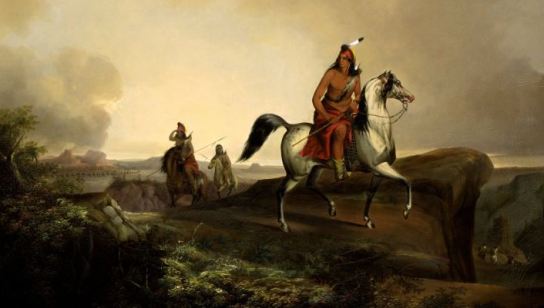
For those of you who don’t know, Missouri is a Native American word. It seemed the best way to settle the matter was discover how the name of that tribe was originally pronounced.
This was not as easy as you might think. For one thing, white explorers typically got the name for a tribe they were about to visit from the tribe they were currently with. And that name was not what those people called themselves. Both Navajo and Cherokee are names other tribes gave them. They call themselves Dine and Ani-Yun Wiya (there’s some accent marks I can’t render here).
The word came down through a French filter, and other settlers would speak it using their own language characteristics. In other words, it was looking like I might have to find a Tardis and convince Dr. Who-ever-it-is-at-the-time to take me on a trip.
It turned out a car was good enough and Hubby was my pilot. We were traveling through Oklahoma. For those of you who don’t know, that state was originally known as “Indian Territory” because during one part of our history the benevolent government decided the best way to handle the “Indian problem” was to dump them all in one location.
Did my sarcasm drip enough here?
We stopped at a park where there was a display listing the names of tribes in this country … and how they were pronounced! At long last, I was going to settle the matter on how my home state should be said.
And that was when I discovered that Missouri is pronounced: Mih – zur – ee – ah.
What? Really?
Hubby came to his conclusion naturally. “Well, that settles it. You just drop the last syllable, and you have Missouree.”
My gracious response was “Not so fast, bub. You can’t assume the last syllable gets dropped.”
My discovery only muddied the water, which I suppose is appropriate. On a side note, it used to be claimed that the translation of Missouri was muddy water. I think this idea was inspired by the Missouri River, which has historically been described as “too thick to drink and too thin to plow.”
I suppose I could be stiff-necked and go around saying Mih-zur-ee-ah, but people who know me already have the local looney bin on speed dial. Those who don’t know me would only back away slowly.
So when it comes to how to pronounce Missouri … we’re all wrong. But now you know!
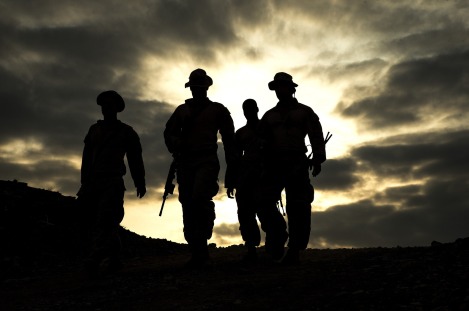
He never liked taking prisoners, but this particular mission unsettled Reuben more than usual.
Earlier today he received orders to lead his section into the mountain range and intercept a citizen hiking to an enemy post. Their scout, a local who lead them here, was also the one who provided the intel that their quarry was going to betray details about the squadron.
The captive, a “business partner” of their informant, sat on the ground, hands cuffed behind him. His arthritic knees had kept his pace slowed, compensating for the hour head start he got on them. And unlike the military combatants Reuben and his team usually tangled with, this resident practically surrendered once they caught up.
His mouth, however, was not so cooperative.
Perhaps it was because Keegan was the youngest of the team – all of them were well under thirty, for war’s appetite is insatiable for the blood of youth – that the forty-ish prisoner launched tirades at him about how all of them were going to pay for this affront.
“And you!” He stared at the young man with confident arrogance. “I’ll see to it that they give me your head on a platter!”
“You want fries with that?” Keegan was standing nearby and appeared distracted with scanning through a confiscated data terminal. Tyrone and Candice stood guard over the prisoner. Their guide, Perkins, paced around the clearing while they waited for the remainder of the section to return from surveilling ahead on the trail they would soon abandon.
Reuben did loath capturing civilians. Considering the propaganda the citizenry was deluged with, there were bound to be some individuals who believed the resistance movement was counterproductive to their prosperity … as anemic as it was. Others preferred to hedge their bets with the established authoritarians who wielded the power of enforcement.
Before their captive could launch into another berating, Lorenzo and Tamika returned from reconnaissance. The wispy woman that people tended to underestimate nodded in affirmation to Reuben as they approached.
“All’s clear in the perimeter ahead,” she reported. “Nobody is waiting there to follow us back.”
Perkins, who wasn’t quite as old as the prisoner, smiled at her news. “Excellent, then! Let’s head on to the pass.”
The five people in his section looked to Reuben, who felt his gut clench upon hearing Perkins’s words.
Although they hadn’t needed a guide to follow the well-established trail their quarry took, Perkins was going to lead them on an alternate route going back. It was standard procedure to avoid any routine the enemy could exploit to trace them.
And maybe that was the final, elusive clue that justified how Reuben’s enteric nervous system started twitching when he received these orders.
Perkins had been able to provide both information and interpretation. They caught and collared their prisoner without a fight. This mission couldn’t go any more smoothly….
It was his experience that life didn’t cooperate to this extent.
And there was something a little too cocky in their captive’s aggression. Reuben decided it was time to shake things up and see how the pieces landed.
“Yeah … but we’re gonna go ahead and take the trail to get back.”
Perkins stared at him as though he just claimed to spy Bigfoot roasting skewered aliens over a campfire. “That’s suicide. We have much better concealment in the pass I’m taking you to.”
“The pass is a longer route. We know this trail is clear because if our opponents were gonna outflank us, they would’ve done it already.”
“That’s not the point.” Perkins shook his head. “You know the best way to avoid detection is to alter your movements. Changing that protocol would be stupid.”
He noticed, but made no acknowledgment, that Tyrone, Lorenzo, and Tamika started strolling into a circular formation around the scout. “My enemy wouldn’t expect me to change protocol, and it’s my job to keep them confounded. Therefore, we’re taking the trail.”
While their mouthy prisoner looked less confident, Perkins’s face reddened a shade as he pressed his lips together. Then he released an audible breath.
“I still say it’s an idiotic idea, but I don’t have to follow your orders like these poor chumps. I’m taking the safer route through the pass and hope to find you at the trailhead.”
If his thriving suspicion proved to be correct, it would be folly to let this fellow out of their sight. “You may not be under my command, Mr. Perkins, but I would be derelict in my duty to keep you safe if I allowed you to leave alone. You will come with us.”
His face reddened by another shade. “I have the right to go where I want!”
Reuben locked his gaze on the man’s eyes. “It seems to me you doth protest too much.”
Perkins stared back for a few seconds, and then spun around and bolted.
Tyrone and Lorenzo had already flanked him. The first man tackled Perkins, and Lorenzo leaped into the fray a second later. The struggle lasted only a few seconds before they hauled Perkins back to his feet, each serviceman holding his arms twisted behind him.
“You crazy hypocrite!” Perkins spat as Reuben stepped closer to them. “You’ll be sorry for this!”
“Is that because your cronies waiting for us at the pass will get offended when we don’t show up?”
Their informant glared back in silence.
Tamika approached to slap cuffs on him, but glanced toward Reuben. “I’d like to know how you figured that out.”
“We aren’t out of the woods yet. They may yet come after us, so everybody need to stay sharp.” He surveyed his team with the pride he felt in them. “In other words, keep up the good work.”
As Keegan assisted Candice with pulling the first prisoner up from the ground, he smirked at Reuben. “So for your next trick, are you going to make him believe he’s a pigeon?”
###
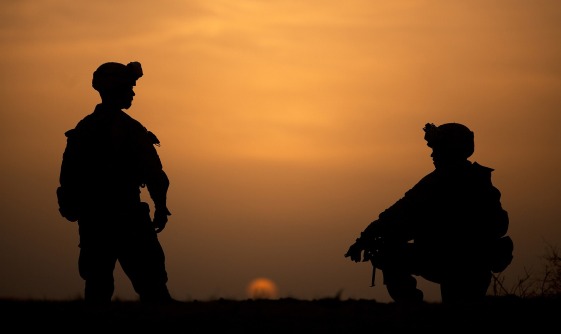
With this month’s prompt word for #BlogBattle being intercept, I was immediately put into a military frame of mind again. Consider this episode to be something of a prequel to the entry I submitted last month. And be sure to follow the Blog Battler link where you’re bound to discover other stories to enjoy!
When I was in the checkout at the grocery store once, the cashier accidentally entered the wrong amount of money I handed her and confused the register.
She hissed “@$#*!” and then slapped her hand over her mouth and murmured, “Oh, sorry.”
I smiled with understanding, but my interior voice said, “You know, you wouldn’t risk offending the customers if you didn’t cuss habitually.”
It’s time for a confession: I don’t curse … out loud. The filter between my brain and my mouth (or fingers) is fully engaged. I just hope it doesn’t go on the fritz when I become an old woman, causing me to walk around humiliating sailors.
What is it about the language that we use “colorful” words? It seems that in moments of high negative emotion we need to be able to erupt with something short (about four letters), vivid (the shade is usually blue), and abrasive (there’s a nicer word for that).
And yet there are those who don’t need high negative emotion to employ such speech. Like the rooster who crows “Cock-a-doodle-do,” their mantra seems to be “Any mood’ll do.” (Yes, I noticed the rooster used fowl language.) But what are the ramifications of peppering everyday conversations with swear words?
Language does change. There are naughty words in history that are acceptable today (like nasty, interestingly enough), and there are some historically common words that are taboo in modern times (I will neither confirm nor deny what those are). They can also vary among cultures: If I say “bloody rooster” in the US, it means we’re having him for dinner. In the UK, he wouldn’t come to dinner because I’ve just insulted him.
There has been a trend in this culture for people to swear more. I don’t know if they think it makes them appear independent and self-determining, but to me it makes them appear to have the vocabulary of a barnyard rooster.
Time for another confession: I will curse out loud during moments of high negative emotion (“There’s a %#*$ snake in the chicken house!”), or within certain parameters for humor (wait for it….).
It would seem that naughty words are kind of like Christmas, which comes only once a year. When used sparingly, they maintain the potency they’re meant to convey. But if they get used casually, they just become dull and plodding. Remember, Monday comes every week.
I’m going off the rail this week, but hey, it’s my blog, I can shake things up if I want to. The events in the following story are all true. Only the names of the innocent have been changed (except nobody in this account is innocent, so don’t worry about it).
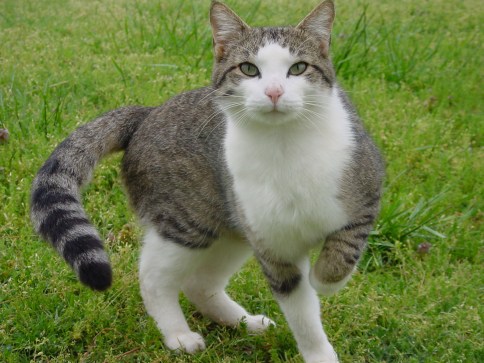
A lifetime ago in cat years, I heard plaintive mewing in the woods behind our house. When I went to investigate, a gray and white kitten saw me coming and assumed I was hungry, so he dove into the center of the woodpile he’d been standing on. I called to him for a little while, shrugged, and assumed he was hungry.
Instead of running back into the house to hide, however, I set out a bowl of scraps for him next to that woodpile.
The way to a kitten’s heart is through his stomach. He adopted us, and we named him Woody.
Woody proved to be exceptionally intelligent. For example, one evening I brought a batch of chicks home from the hatchery, made sure they got squared away safely in the stock tank we used as a brooder, closed the doors of our workshop, and went to bed.
The next morning I opened the workshop … and out walked Woody. Yikes! I’d accidentally locked him in overnight with a buffet of fluffy meatballs!
I’d already seen this cat use mouse tails to floss feathers out from between his teeth. This was also the cat that left dead frogs on our porch to show how much he loved us. My only hope was that there had been enough chicks in the tank that he decided to leave some for leftovers after he ate his fill.
But to my surprise and relief, not only were all the chicks there, nobody was experiencing post-traumatic stress. For a minute I thought Woody might not have even realized they were there, but then I noticed something.
Against the wall of the tank there was a cat-sized depression in the shavings. Woody had found a warm place to nap during the night. I suppose counting chicks helped him to fall asleep.
Fast forward a few years. Woody was middle-aged, and our younger son wanted a kitten.
Enter Toni.
Toni loved Woody. The feeling wasn’t mutual. After the initial hissing and swatting, Woody then shrugged his shoulders and accepted that she lived here, too. It’s possible he might have been able to take a liking to her, except….
Toni’s favorite game was Ambush. One time Woody was walking by the car when she leaped out from underneath, tap danced on his noggin, and then shot off to vanish into the barn.
Woody wheezed and gasped and sputtered before he finally got out his hiss.
Despite his near occasions of heart attacks, Woody lived a long and full life. The fact Toni grew out of ambushing him probably helped. But eventually old age took Woody from us, and we agreed that the next time there was an opportunity to get a free kitten, we’d take it.
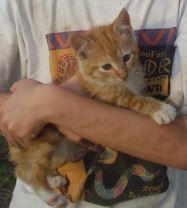
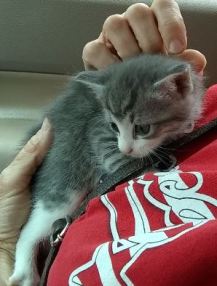
Enter Truman.
One of the reasons we selected him from that box of barely weaned sugar-pusses was because his color sort of reminded us of Woody. And until he got big enough to move outside permanently, we used his alfresco excursions to introduce him to Toni.
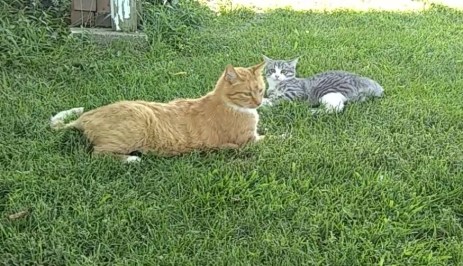
Truman loves Toni. The feeling isn’t mutual. After the initial hissing and swatting, Toni stuck out her lower lip and accepted that he lives here, too. It’s possible she might be able to take a liking to him, except….
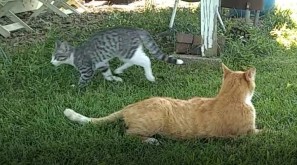
Toni is old enough to qualify for the senior discount at the grocery store, but at least for nearly all her life she’s been accustomed to having another cat around. We think Truman messes with her mind. Sometimes she’ll run up to him and sniff noses … and then hiss.
She possibly thinks he’s Woody (they even look similar, for crying out loud!), but it might not be disappointment that hits her when she realizes he isn’t.
Sometimes we wonder if Toni suspects the day is coming that Woody will get his revenge through Truman. That one day she’ll be minding her own business when he suddenly bounces off her brainpan and it takes her twenty seconds to get her hiss out.
Oh, and in case you were wondering, I’ve never lost a chick to a cat. It’s as though Woody took the time to instruct Toni that she can eat anything else she catches, but the chicks are off limits. Hopefully his legacy will live on through Truman. In a way it’s like he’s up there in cat heaven looking down on us, a hissin’ and a grinnin’ the entire time.
Several years ago I worked as a school secretary. Occasionally my tranquil day of answering the phone, printing handouts, filing records, sorting mail, taking temperatures, etc. would be enlivened with parents who would enter the office and say, “May I ask you a question?”
My canned response was “Go ahead. If I don’t know the answer, I’ll make up something.”
They were probably relieved when Hubby got a new job and we had to relocate.
Fiction writers are probably the biggest liars out there (my mistake … we’re right behind politicians). But readers are willing to suspend disbelief because they expect us to entertain or inspire or instruct them with a compelling story.
Any conman will tell you the most effective lies are seeded with truths (I feel like I’m contributing to the delinquency of readers here). It’s no surprise the best stories, no matter how fantastical they are, get embraced because they speak from a reality people can identify with.
Writing any genre of fiction will involve throwing in some facts, but part of the fun is twisting reality to fit your vision. Luckily for fiction authors, history is full of holes, contemporary time presents unknowns, science is still working out theories, and fantasy has been with us since the first caveman said “Hrmph!” (translation: What made that sound?)
It makes you wonder about the underlying psychology of writers. What twisted component in our brain makes us want to engage others in our flights of fancy? Are we really that needy for attention?
Yet ironically, many writers tend to be introverts. And since most of us are avid readers ourselves, can you really call it a symbiotic relationship between storyteller and audience?
I think it boils down to we just got to be crazy. See, when I don’t know the answer, I can make up something….
Okay, the plot to your story is planned, your characters are developed, and all that’s left to do is get writing. But after you finish it you discover that, like a plot twist, something went wrong.
You read it and it falls flat despite your brilliant ideas. Or worse yet, a beta reader gives it back to you with a shrug and an “Eh.” And that’s when you realize the words on the page are merely functional. They need some zing and zap to make your writing sparkle.
We’re going beyond the show, don’t tell concept here. We’re going to dissect the words themselves (ew, gross!).
The thesaurus is one of my best friends (and I’ve always been a dinosaur nut as a kid … sorry, couldn’t resist). “He cried out” may not be precise enough for the image you want to project. Maybe he actually yowled, or bellowed, or squealed, or yammered.
Throwing in some alliteration can get certain phrases to click. Repeated letters in words draw attention to them, conveying they mean more than their simple dictionary definition (draw dictionary definition … isn’t that sold as Pictionary?). They are also used to boost memory or create a mood or (attempt to) insert humor.
Reading the story aloud can help (hint: do this when nobody is around to call the people with butterfly nets and those long-sleeved jackets). Is there a pleasant rhythm to the way your words flow together, or do they seem to clank and clunk? Think of the flow of poetry and vary the length of sentences.
As in all things, moderation is the key, or you wind up with the dreaded purple prose. If you’re unfamiliar with what that is, it sounds something like this:
It was a bright and sunny day. The radiant daystar, that golden orb and glorious lamp of heaven, prodigiously illuminated the proliferous landscape with aestival and resplendent effulgence that inspired the everlasting soul and prompted Peter to pipe vociferations while he pranced out to his pepper patch and picked a peck to pickle for the parish picnic.
You’ve probably heard of the adage for “Write what you know.” But how much thought have you given to NOT writing what you know?
I know, I know, it sounds likes I’ve gone off the deep end, but bear with me….
Remember that character in your story who’s become your imaginary friend? How did he/she/it get to be that way? Do you catch yourself starting to set a place at the table for [insert name here] because you think about that story so much your fiction has blurred with reality?
(I’ve never done that … yet.)
And if you did, what will your buddy have for breakfast?
One of the best ways to make characters real to the readers is for them to become real to the writer first. They can’t emerge as three-dimensional unless they exist that way to you. J. K. Rowling commented about Harry Potter that she knew things about him that would never make it into the story.
You should know details about the characters that readers wouldn’t want to know. What’s his routine in the bathroom every morning? How does she plan her outfit for tomorrow before she goes to bed? How does it recharge while everybody else is sleeping?
Admittedly putting this much thought into your story development can spill over into daily life. I did once call one of our kids by the name of the protagonist in a story I was working on (But I don’t feel badly about that … Hubby has called him by the dog’s name.). If family and friends are wondering if you need to be committed, that’s just evidence you’re committed to the story.
Just don’t go off the deep end!
Note: If you don’t know what Ding Dongs are, they’re kind of like chocolate Twinkies. If you don’t know what Twinkies are, then I can’t help you….
“Poke it with a stick.” Keegan didn’t look at him as they kneeled in the brush and gazed at the grounded combat device lying at the edge of the clearing.
Reuben did cast a quick glance at the young sergeant before responding in an equally low voice. “That’s your answer to everything.”
“No, my everything-answer is to shoot it, but I know you won’t let me do that this time.”
Shooting the Unmanned Aerial Vehicle was as inadvisable as poking it. They didn’t want to give away their position, but the fact it was no longer airborne caused his suspicion to cook up various scenarios.
Earlier that day the flight under his command completed their mission of taking down a supply convoy. In typical guerilla style they disabled the vehicles, pillaged the enemy’s equipment, and scattered in sections of two. He and Keegan, with their loot of mostly communications paraphernalia, were cutting through the forest to regroup with their fellow combatants.
The sergeant had spied the derelict UAV a split second before Reuben did. They both dove for cover behind some buckbrush and used the momentary stillness to determine what course of action was most advisable now that their situation was less stable than before.
“What worries me is we haven’t heard any fire exchange.” Reuben kept his gaze on the military drone. “If that got grounded in a skirmish, it’s been there a while. Have they really lost it or are they still using it for surveillance?”
“That wouldn’t make sense.” The sergeant chewed on his lower lip. “Those UAVs are more efficient up in the air. They aren’t going to waste resources by leaving one on the ground.”
“Which brings us back to the question why they haven’t retrieved it already.” His eyes narrowed as he regarded the devious drone. “Maybe it isn’t salvageable, but considering it’s a target model, it could be either unstable enough or just reprogrammed to blow if somebody else tinkers with it.”
Keegan seemed to freeze for a few seconds before his lips pressed together. “Like a civilian hoping to cannibalize it for some parts. Jiminy, I hate it when you come up with these worst-case scenarios.”
Reuben shook his head. “Then we need to investigate it.”
“Screw that. Just let me shoot it.”
“I’d rather not advertise we’re here if we can avoid it. But if it’s active, I’m hoping to disarm it.”
“Really? And if you wiggle the wrong wire, you could find yourself disarmed. And dis-legged. And dis-headed.”
“We won’t have to get that close.”
The sergeant cast a sidelong glance at him. “What delusions of grandeur are you having now?”
“Some of our booty includes reconnaissance equipment. All we’ll have to do is pilot a micro drone down there and see what readings it gives us. If that UAV is dead, then we can scoot outta here in good conscience. If it’s booby-trapped, we’ll use the same peewee to reprogram it into pacification.”
“That’s why they made you the captain.” Keegan smirked. “But you do realize that if it’s active and we monkey around with its system, they might still figure out our position from the sensor readings?”
“The odds are much smaller than if you get trigger-happy.”
“Well, I guess I’ve had enough explosions for today. Let’s get a tactical drone down there.”
The tiny UAV they unpacked was about the size of a fat quarter sporting four round propellers. After it established its radio link to the palm-sized readout system, Reuben operated the drone while the sergeant helped to guide its position. It skimmed over the larger UAV that resembled a torpedo with extra fins.
Keegan also watched the screen as the drone’s signal fed data back to the device. “Crap, it’s armed. I hate it when you’re right.”
“Let’s see if we can get the pen to be mightier than the sword.” Reuben tapped on the screen to direct their stolen drone to sync with the UAV’s system.
“At least they’re talking to each other,” the sergeant murmured. “I just hope nobody else is listening to that conversation.”
“I doubt it’s being monitored since they wouldn’t be expecting somebody to do what we’re doing.”
“This is one time I’d be happy if you’re right.”
There was something satisfying about using the enemy’s own technology against them. As Reuben negotiated with the grounded UAV through the tiny drone, he was encouraged this plan was going to succeed. And that, said a small, still voice in the back of his mind, is when trouble happens.
His comrade drew in a sharp intake of air. “That display looked like a power spike.”
That was their only warning. With a thunderous boom, ragged metal and twisted components shot in every direction.
As they sprang to their feet to beat a hasty retreat, he thought he heard Keegan gasp “Should’ve poked it with a stick!” Considering the consequences as they galloped into the forest, he figured they might as well have.
###
So here is this month’s contribution to #BlogBattle. As usual, it’s sparked plenty of interesting ideas from other people, so feel free to check out the other stories that have been submitted!
I’ve had more than one person tell me they’ve started a story, but then they’re so eager to rush to the end they wind up floundering in the middle and quitting.
They don’t get stuck because the middle is there to fill up space until you get to the end. They get stuck because the middle is extremely crucial. If the middle of your work isn’t as compelling as the beginning and ending, you’ve got work to do.
This is where the plot and characterizations get a workout. A flashy beginning and an explosive ending don’t mean squat without the middle to tie it all together. And if you lose your momentum in the middle of the story, the reader might not bother going to the end.
So what’s one suggestion to keep your middle rolling?
Readers love it when the bad stuff characters go through in a story gets worse. It’s not because we’re all sadists at heart, but it gives us more reason to root for the character. If Frodo got to skip off to Mordor and flick that wretched ring into a barely active volcano, readers would yawn.
So in a nutshell, this is when you make things worse for your characters. The Law of Murphy rules. And if you find it’s a struggle to write a middle worth its mettle, just keep telling yourself what you tell your protagonist: What doesn’t kill you will only make you stronger.
Pixabay.com
And on that note, Happy Birthday America! Whew, I’m glad I made it to the end of this blog….
Completing a story is not as cut and dry as one might think. You don’t necessarily want to put a bow on it. “They lived happily ever after” worked for the brothers Grimm, but life in general doesn’t work out that way.
Like life, the ending is going to be influenced by everything that happened before. Cowboys riding off into the sunset became a standard conclusion to a western movie, but it’s not the kind of thing that will make the reader close your book with satisfaction. As the story was unfolding, did you make any promises about what might happen to Wrong-way Joe and his trusty mount?
When Joe takes the left fork instead of the right at the pass, he meets folks and does things he wasn’t expecting when his adventure began. For a typical novel, you want to wrap up any loose threads and give some idea to what happens with the main characters. If the reader cares about them at all, this information will be necessary.
Maybe he met a raven-haired gal with an unerring sense of direction. If you do want them to ride off together into the sunset, she can redirect his courser to the south when Joe accidentally turns north.
But if he kisses her and she turns into a raven, the twist ending shouldn’t exist for the sake of making the reader exclaim “What the nevermore!” That’s the sort of thing that can also make a reader declare, “I will nevermore read that author.”
If there’s going to be a surprise at the end, you must set up the logic to why it happened. Earlier in the story the reader needs to discover something like she is the descendent of a legendary skin-walker in her tribe, and she has an affinity for shiny baubles.
An ending can also be a bit up in the air, and to what degree it is often depends on the length of the story. Readers like having something left to their imaginations to a point, but short compositions lend themselves more to a conclusion that’s barely there.
In the abbreviated version, the tale might end with Raven watching Joe head the wrong way as he leaves her village to (attempt) getting to his original destination. The reader is left wondering if she will set him straight or allow him to wander.
This type of ending also lends itself more to literary works or dilemmas that aren’t earth shattering.
And finally, returning to a novel (or series) length of story, a writer can double-dip on the ending by using an epilogue. This takes place separated from the rest of the tale by time and/or distance, yet it ties to the consequence of that story.
What kind of epilogue could happen with Wrong-way Joe and Raven and his fiery steed? I think I’ll leave that one to your imagination!


 I’d already seen this cat use mouse tails to floss feathers out from between his teeth. This was also the cat that left dead frogs on our porch to show how much he loved us. My only hope was that there had been enough chicks in the tank that he decided to leave some for leftovers after he ate his fill.
 Enter Toni.
 Enter Truman.
 Oh, and in case you were wondering, I’ve never lost a chick to a cat. It’s as though Woody took the time to instruct Toni that she can eat anything else she catches, but the chicks are off limits. Hopefully his legacy will live on through Truman. In a way it’s like he’s up there in cat heaven looking down on us, a hissin’ and a grinnin’ the entire time.



 a. e. branson